
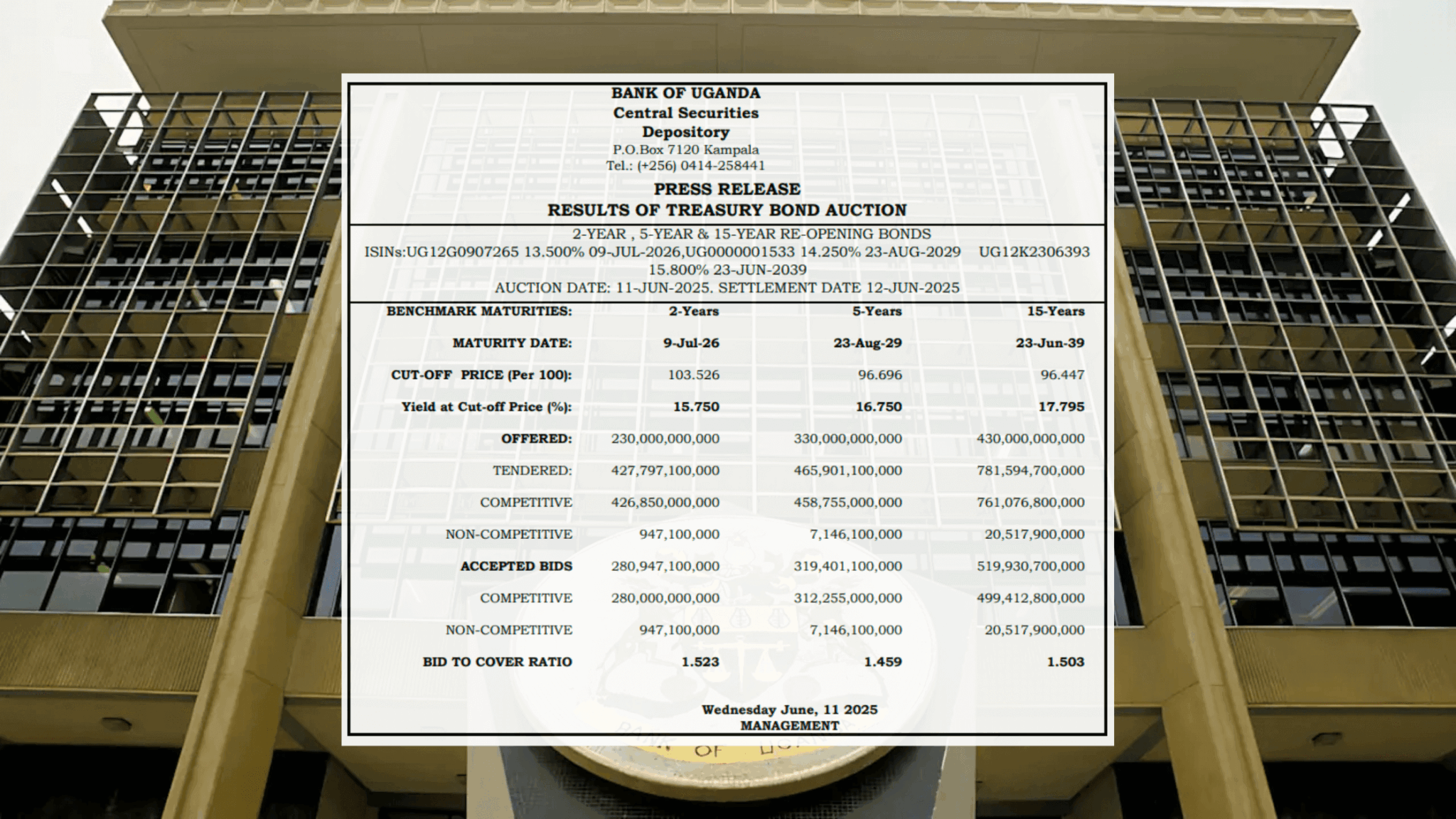
On 11 June 2025, the Bank of Uganda held a Treasury Bond auction involving the reopening of three Government of Uganda bonds: a 2-Year Bond, 5-Year Bond and 15-Year Bond.
Because these were reopenings, the securities had already been issued previously and were offered again to raise additional funds.
The auction attracted strong investor demand across the three maturities.
Here are the results and what the numbers meant for investors at the time.
June 2025 Treasury Bond Auction Results
The following Treasury Bonds were reopened:
| Bond | ISIN | Maturity Date | Coupon Rate | Cut-off Yield |
|---|---|---|---|---|
| 2-Year | UG12G0907265 | 9 July 2026 | 13.500% | 15.75% |
| 5-Year | UG0000001533 | 23 August 2029 | 14.250% | 16.75% |
| 15-Year | UG12K2306393 | 23 June 2039 | 15.800% | 17.80% |
The auction raised approximately:
- UGX 280 billion from the 2-Year Bond
- UGX 312.26 billion from the 5-Year Bond
- UGX 499.41 billion from the 15-Year Bond
These figures are historical and relate specifically to the 11 June 2025 Bank of Uganda Treasury Bond auction.
For current Treasury Bond yields, see Treasury Bond Rates in Uganda.
Coupon Rate vs Cut-off Yield
One important distinction when reading Treasury Bond auction results is the difference between the coupon rate and cut-off yield.
The coupon rate determines the interest payments attached to the bond.
The cut-off yield reflects the yield at which successful competitive bids were accepted during the auction.
For example, the reopened 2-Year Bond had a 13.500% coupon rate, while its auction cut-off yield was 15.75%.
These numbers should not be treated as the same thing.
The bond does not suddenly begin paying a 15.75% coupon because the auction produced a 15.75% cut-off yield.
This distinction is particularly important with reopened bonds because their market price can be above or below their face value depending on prevailing yields.
What Did the June 2025 Results Show?
Investor demand was strong across the auction.
The 15-Year Bond attracted particularly significant demand, with investors submitting approximately UGX 781 billion in bids and about UGX 499 billion being accepted.
The auction also produced an upward yield curve across the three maturities:
- 2-Year Bond: 15.75% cut-off yield
- 5-Year Bond: 16.75% cut-off yield
- 15-Year Bond: 17.80% cut-off yield
At that auction, investors therefore required progressively higher yields for the longer-dated bonds.
That does not mean longer-term Treasury Bonds will always offer higher yields. Market conditions, inflation expectations, monetary policy and investor demand can all influence yields at future auctions.
How Treasury Bond Returns Work
Treasury Bonds generally provide investors with two important cash flows.
Coupon Payments
Government of Uganda Treasury Bonds generally pay coupon interest every six months.
The amount is determined by the bond’s coupon rate and face value.
Principal at Maturity
If the bond is held until maturity, the Government of Uganda repays its face value at maturity, subject to the applicable terms.
Investors who buy or sell bonds in the secondary market before maturity may transact at prices above or below face value.
Example: UGX 1 Million in the 2-Year Bond
The reopened 2-Year Bond had a 13.500% coupon rate.
For a face value of UGX 1,000,000:
Annual coupon = UGX 135,000
Because Treasury Bond coupons are generally paid every six months:
Semi-annual coupon = approximately UGX 67,500 before applicable taxes
This is different from simply multiplying UGX 1 million by the 15.75% cut-off yield.
The yield and coupon serve different purposes when evaluating a bond.
What Does Strong Demand Mean?
High demand at a Treasury Bond auction means investors submitted bids exceeding the amount the government ultimately accepted.
This can provide useful information about investor appetite for government securities at particular maturities and yields.
However, high demand does not by itself tell you whether a particular Treasury Bond is suitable for your financial goals.
Investors still need to consider factors such as:
- Time to maturity
- Coupon rate
- Purchase price
- Yield
- Liquidity
- Interest-rate risk
- When they may need access to their money
Can You Still Buy These Bonds After the Auction?
Treasury Bonds do not necessarily disappear once a Bank of Uganda auction ends.
Previously issued Government of Uganda Treasury Bonds may be available through the secondary market, depending on availability.
Their price and yield can differ from the original auction results because market conditions change over time.
Through Level Africa, investors can access available Government of Uganda Treasury Bonds digitally.
How to Invest in Treasury Bonds Through Level Africa
You do not need to wait for the specific auction covered in this article to explore Treasury Bonds.
Available bonds can be viewed directly through Level Africa.
1. Create & Verify
Create your Level Africa account and complete the required verification.
2. Fund Your Wallet
Add funds to your Level Africa wallet.
3. Choose a Treasury Bond
Review the Treasury Bonds currently available and consider factors such as maturity, coupon, yield and investment period.
4. Invest & Track
Complete your investment and track it through your Level Africa account.
Where to Find Current Treasury Bond Information
The June 2025 figures on this page should be treated as a historical record of that particular auction.
For current information, use:
Current Treasury Bond Rates in Uganda for current and historical yield information.
Bank of Uganda Treasury Bond Auction Calendar for upcoming auction dates.
Treasury Bonds in Uganda to explore Treasury Bonds available through Level Africa.
Frequently Asked Questions
What happened in the June 2025 Bank of Uganda Treasury Bond auction?
Bank of Uganda reopened 2-Year, 5-Year and 15-Year Government of Uganda Treasury Bonds on 11 June 2025. The cut-off yields were 15.75%, 16.75% and 17.80% respectively.
What is a Treasury Bond reopening?
A reopening occurs when the government offers additional amounts of a Treasury Bond that was issued previously rather than creating an entirely new security.
The reopened bond retains characteristics such as its existing maturity date and coupon rate.
What is the difference between a Treasury Bond coupon and yield?
The coupon determines the periodic interest payments attached to the bond.
Yield measures the return implied by the bond’s price, coupon payments, maturity and other factors.
A reopened bond can therefore have a coupon rate that differs from its auction yield.
How often do Uganda Treasury Bonds pay interest?
Government of Uganda Treasury Bonds generally pay coupon interest every six months.
Can I buy Treasury Bonds after an auction?
Yes, previously issued Treasury Bonds may be available on the secondary market, subject to availability and prevailing market prices.
Can I invest in Treasury Bonds through Level Africa?
Yes. Investors can explore Government of Uganda Treasury Bonds available through Level Africa and invest digitally through the platform.
Are the June 2025 yields still the current Treasury Bond rates?
No. The yields in this article are historical results from the 11 June 2025 auction.
Treasury Bond yields change as new auctions take place and secondary-market conditions change.
For the latest information, see current Treasury Bond rates in Uganda.